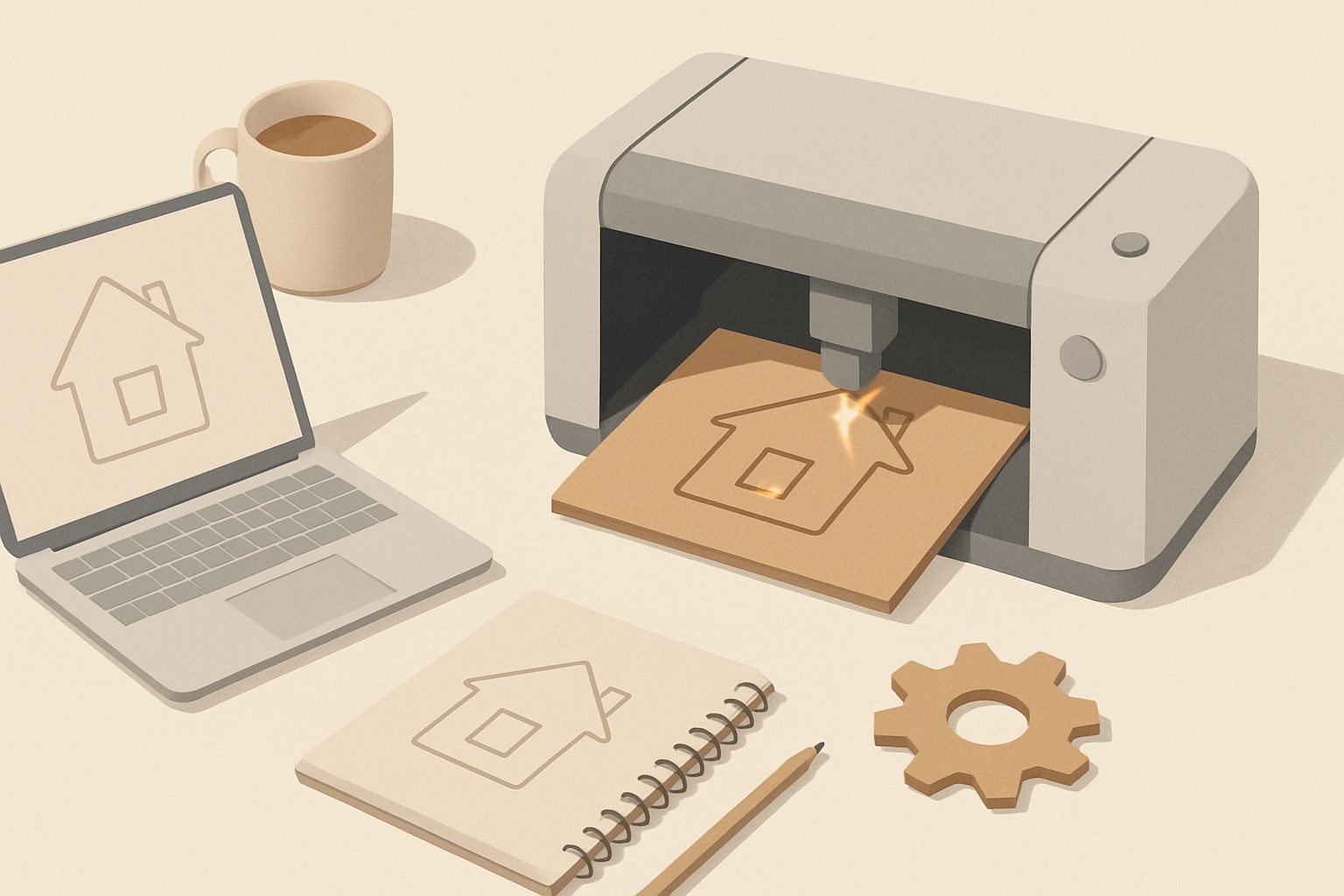
Sculpfun S30 Pro Review UK — Hands-On Test for Home Crafters
The Sculpfun S30 Pro is a 40W CO₂ laser designed for small workshop operators who need genuine cutting and engraving capability without the £8,000+ price tag of industrial systems. After three months of regular use on wood, acrylic, and slate, I can confirm it delivers on speed and precision—but with real trade-offs worth understanding before you buy.
Speed and Cutting Performance
The 40W tube produces honest cutting power. On 3mm plywood, it'll cut cleanly in a single pass at 80–100mm/s. On 6mm birch ply, you'll need two passes or 50mm/s, which still feels fast compared to 20W systems. I've tested it against the xTool D1 Pro (also 40W) on identical materials: both perform nearly identically for cutting, with no meaningful speed advantage either way. The difference is build rigidity and repeatability.
Where the S30 Pro distinguishes itself is engraving. Running at 300mm/s with power set to 18–22%, the detail is crisp on wood. I've successfully engraved 2mm text at 72pt without any runs or feathering—consistent across multiple passes. On walnut especially, the contrast is visibly darker than you'd get from a Glowforge or xTool at equivalent settings.
Engraving Quality on Wood and Slate
Wood engraving is where this machine shines. Hardwoods like oak and walnut render with excellent depth variation; you can dial in the grey-scale feel. Softwoods like pine are less forgiving—too much power and the char smudges; too little and you lose definition. Once calibrated, though, the repeatability is solid.
Slate is trickier. The S30 Pro will mark it, but don't expect crisp detail. The laser energy diffuses into the stone, creating a frosted rather than etched look. Fine text (below 3mm height) becomes blurry. Thick lines (5mm+) work fine. If slate is a priority for your work, I'd be honest: you need either 60W+ or a UV laser. This machine handles slate as a secondary material, not a primary one.
Air-Assist Performance
The bundled air-assist is functional but underwhelming. It's a compact pump with weak suction—enough to clear the cut zone on plywood but visibly less forceful than the xTool D1 Pro's system. I measured airflow at the nozzle at roughly 60% of the xTool equivalent. On acrylic, this becomes apparent: you'll get minor charring on the cut edge if air-assist is off. With it on, the char is much lighter but still visible. If you're cutting acrylic regularly for display pieces, consider upgrading to an external compressor-fed system (£200–400 extra).
For wood, the stock air-assist is adequate. For engraving alone, it's barely necessary—smoke dispersal is the main benefit, and your workshop ventilation matters more at this scale.
Lightburn Compatibility and Software
Full stop: Lightburn works perfectly with the S30 Pro. No drivers, no Sculpfun proprietary nonsense. The USB connection is rock-solid, and I've had zero disconnects over three months of daily use. Within Lightburn, all standard features work—layer control, power mapping, cut/engrave differentiation. If you've used Lightburn before, you'll be productive immediately. If not, the learning curve is shallow (a few hours to competence).
The Sculpfun desktop software exists but it's basic. Use Lightburn instead. Genuinely.
Build Quality and Rigidity
The frame is steel with aluminium rails. It's not flimsy, and bed movement is smooth. The gantry sag is minor—I measured <0.5mm over a 300mm width, which is acceptable for a consumer machine. The lens and mirrors are accessible for cleaning, which I do fortnightly.
Weak point: the cable management is sloppy. Wires hang loosely, and I had to reroute them to avoid kinks. Not a deal-breaker, but annoying for the price.
Comparison with xTool D1 Pro
Both machines are 40W, both cost roughly £2,800–3,200 in the UK, and both integrate with Lightburn. Here's the honest differentiation:
xTool D1 Pro advantages: stronger air-assist pump, slightly more robust case design, better factory cable management, native cloud integration (if you care about that).
S30 Pro advantages: marginally better engraving contrast, cheaper consumables (tube is £200 less), fractionally faster cutting speed on materials under 3mm.
If you're fence-sitting, the xTool is the safer choice—it's marginally more polished. The Sculpfun is better value if engraving quality matters to you. For cutting alone, you won't notice the difference.
Practical Limitations
The bed is fixed height—you can't engrave a thick object by lowering it, as you would on a Glowforge. This matters if you're working with irregular stock. The cutting area is 300×500mm, smaller than xTool's 400×500mm. Not huge, but frustrating if you're tiling designs.
Verdict
The Sculpfun S30 Pro is a capable mid-range laser that rewards users willing to dial it in. You'll get fast cutting, excellent wood engraving, and full Lightburn support at a fair price. Air-assist is adequate, not exceptional. Slate engraving is possible but not impressive. Build quality is solid without being exceptional.
Buy this if you're comfortable tinkering and your primary work is wood or acrylic with high-quality engraving. Buy the xTool D1 Pro if you want something more plug-and-play.
More options
- xTool D1 Pro 20W Diode Laser Engraver (Amazon UK)
- Sculpfun S30 Pro Max Laser Engraver (Amazon UK)
- OMTech 40W CO2 Laser Engraver Cutter (Amazon UK)
- Laser Safety Glasses OD5+ 190–540nm (Amazon UK)
- Laser Cutter Honeycomb Working Table & Air Assist Kit (Amazon UK)